| |
|
Retired Section Swansea Docks |
| |
|


 |
| |
| |
|
The items shown
below were photographed by Peter Hopkins with the kind |
|
permission of HM
Revenue & Customs at Ty Nant, High Street Swansea |
|
|
|
|
 |
|
Coat of Arms from the former HM Customs & Excise Office at the
Pierhead, Kings Dock, Swansea |
|
|
|
|
 |
|
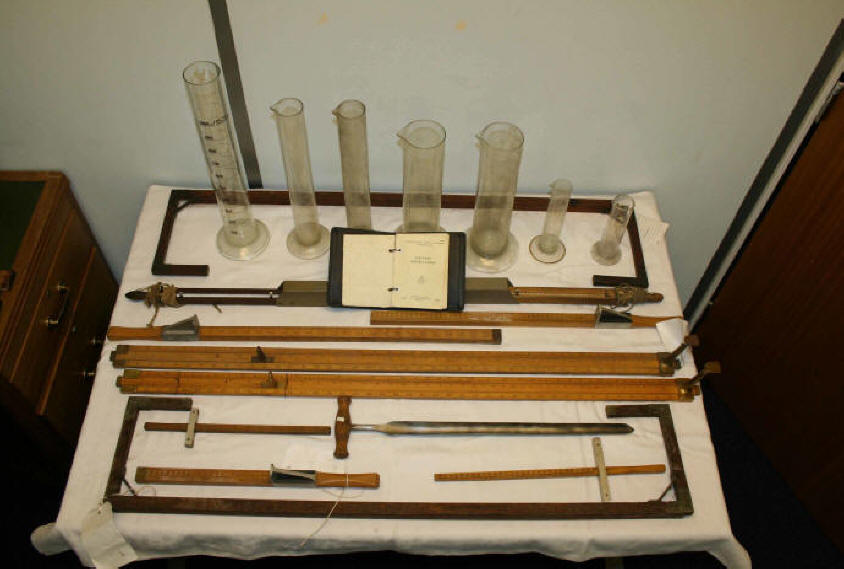
Selection of HM Customs gauging, measuring, weighing, sampling
and testing equipment
|
|
|
 |
|
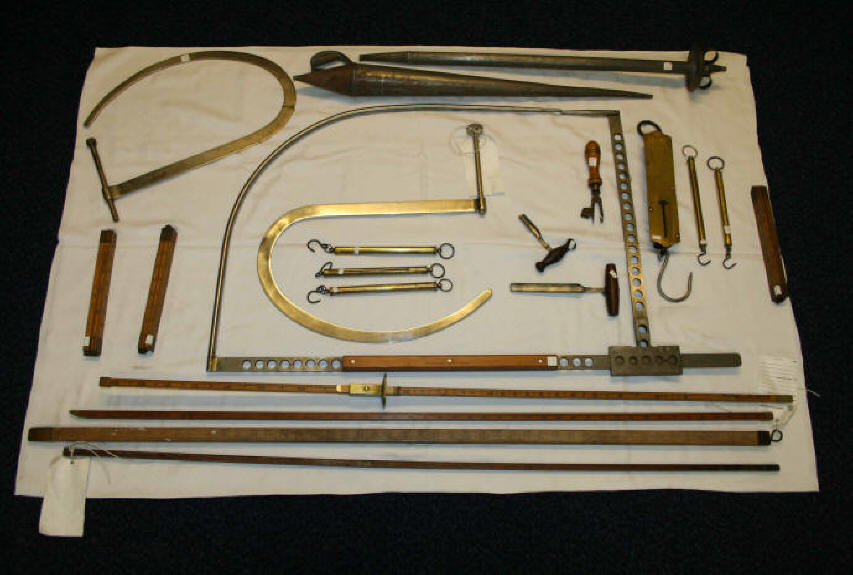
Selection of HM Customs gauging, measuring, weighing, sampling
and testing equipment
|
|
 |
|
The
item bottom right is an optical instrument nicknamed a 'shuftyscope'.
It was used by officers on rummage duties to see into confined
enclosed spaces. It had a light source powered by batteries
and a lens mounted at the end of the tube. In latter years it
was superseded by the endoscope of medical fame.
|
|
Bottom left is a saccharometer hydrometer and top right is a
saccarometer refractometer, these instruments are primarily
used by winemakers and brewers to determine the sugar content
in a solution. HMC&E would use them for revenue purposes.
|
|
The
two books of tables are used in conjunction with readings
taken from a Sikes's Hydrometer (not displayed), to determine
the proof strength of spirits in a solution.
|
|
There
is also a single glass alcoholometer (one of a set) used to
determine the % of alcohol in a solution (ABV).
|
|
Note:- to convert ABV to degrees
proof multiply by 7 and divide by 4 and vice versa. Therefore
a bottle of scotch at 40% ABV is 70 degrees proof and pure
alcohol 100% ABV is 175 degrees proof (or 75 degrees over
proof). |
|
|
|
|
 |
 |
|
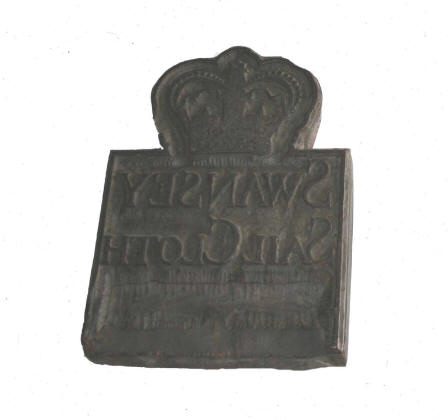
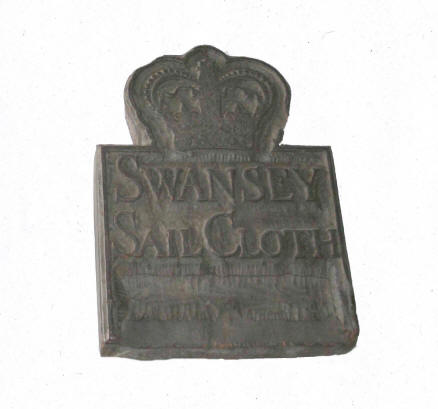
Commissioners of Customs 'Swansey Sail Cloth' stamp |
Commissioners of Customs 'Swansey Sail Cloth' stamp inverted |
|
 |
|
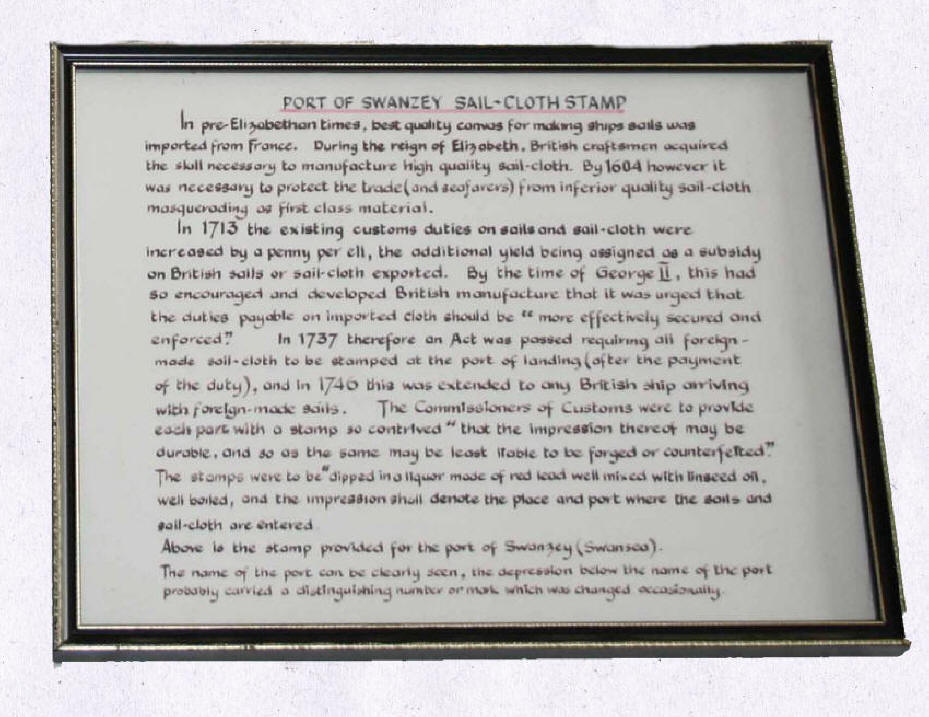
A
framed explanation of the sail stamp (see text below)
|
|
Swansea
Sail Stamp
|
|
In pre
Elizabethan times best quality canvas for making ships sails
was imported from France. During the reign of Elizabeth,
British craftsmen acquired the skill necessary to manufacture
high quality sail cloth. By 1604 however it was
necessary to protect the trade (and seafarers) from inferior
quality sail cloth masquerading as first class material.
|
|
In 1713 the
existing customs duties on sails and sail cloth increased by a
penny per *ell the additional yield being assigned as a
subsidy on British sails or sail cloth exported. By the
time of George II this had so encouraged and developed British
manufacture that it was urged that the duties payable on
imported cloth should be 'more effectively secured and
enforced'. In 1737 therefore an Act was passed requiring
all foreign made sail cloth to be stamped at the port of
landing (after payment of the duty), and in 1746 this was
extended to any British ship arriving with foreign made sails.
The Commissioners of Customs were to provide each port with a
stamp so contrived ;that the impression thereof may be
durable, and so as the same may be least able to be forged or
counterfeited'. The stamps were to be 'dipped in a
liquor made of red lead well mixed with linseed oil well
boiled, and the impression shall denote the place and port
where the sails and sailcloth are entered'.
|
|
To the left is
the stamp provided for the port of Swansey
(Swansea). The name of the port can be clearly seen; the
depressions below the name of the port probably carried a
distinguishing number or mark which was changed occasionally.
|
|
*ell: - A unit
of Measurement mostly for measuring cloth, from
fingertip of outstretched arm to opposite shoulder. - 20 nails
=11/4
yards or 45inches.
(One nail-
three digits = 21/4
inches =
1/16
yard). |
|
|
|
|
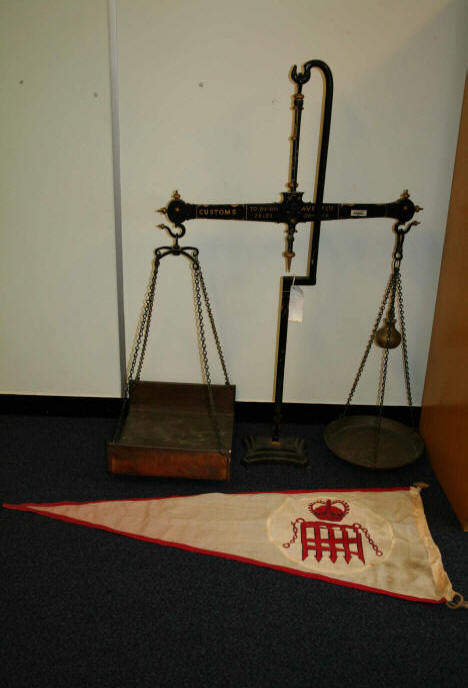
Customs & Excise weighing scales together with a burgee |
|
(pennant) from the HM Revenue Cutter 'Champion' |
|
|
|
|
 |
 |
 |
 |
| |
|
|
|
|
|
|
|
|
|
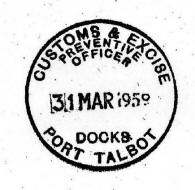
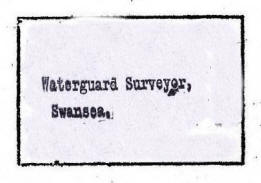
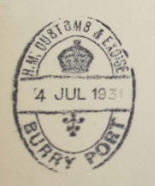
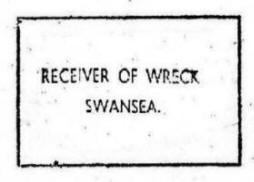
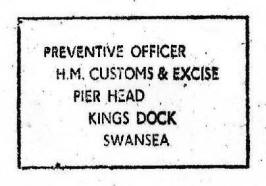
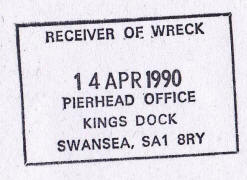
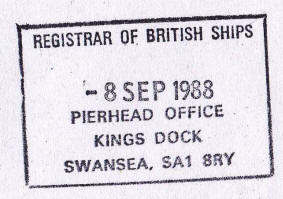
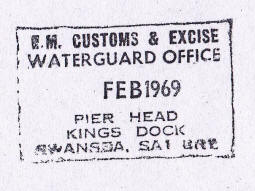
A selection of HM Customs rubber stamp impressions from
Swansea,
Port Talbot, Burry Port and Pembrey
|
|
|
 |
|
Chief Preventive officer's uniform belonging to Swansea's last
serving CPO, Ken Colwill (1972)
|
|
 |
|
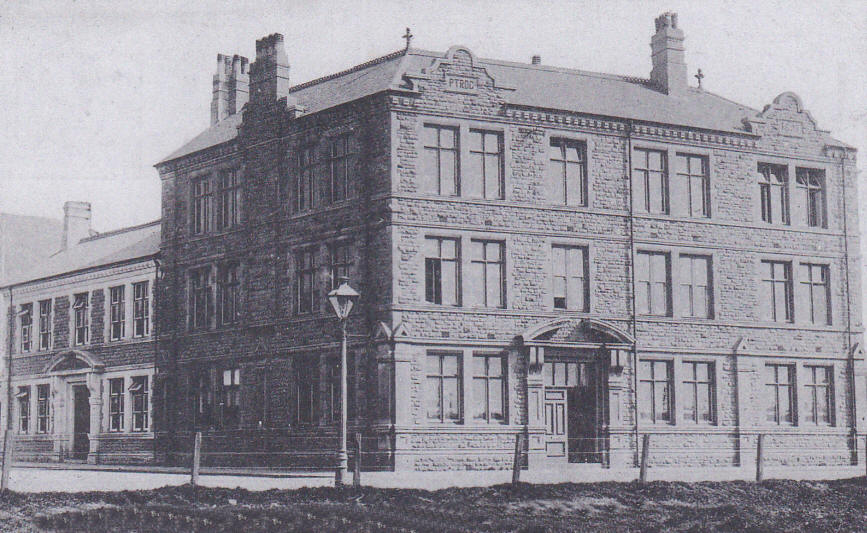
The building on the left is the Custom House in Eagle
Street, Port Talbot, which also housed Immigration staff.
On the right are the offices of the Port Talbot Railway & Docks
Company
|
|
 |
|
The above photograph of Port Talbot Docks was taken
in the early years of the 20th century. The Customs
Waterguard Office, which in later years housed the Port Talbot Small Boat Club, can be seen
at the tip of the funnel of the ship in the lock
|
|
|
 |
|
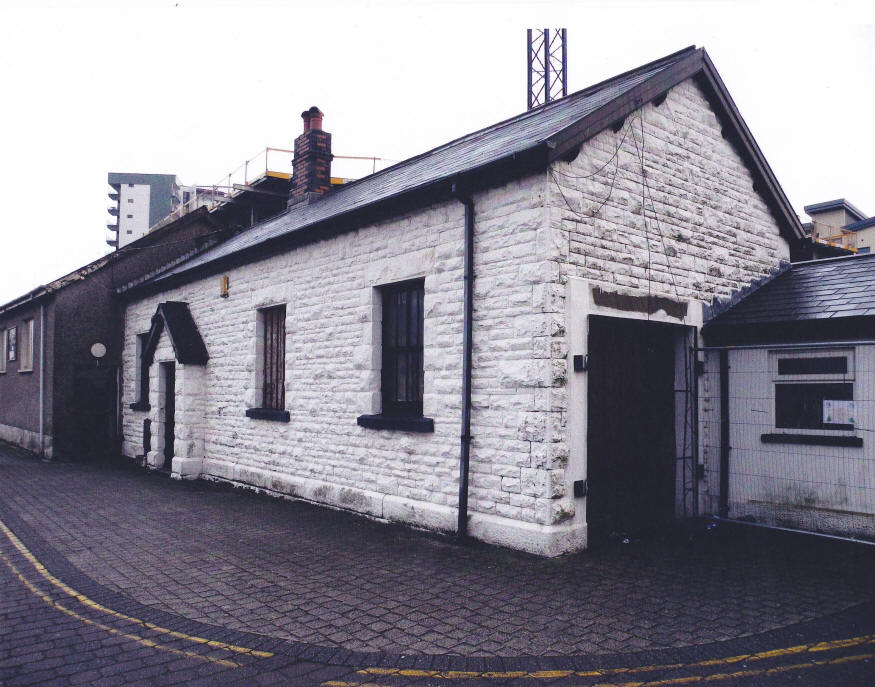
HMC&E
occupied this watch house at the West Pier Swansea until about
1958, it was situated on the seaward side of the castellated
pilot house.
|
|
|
 |
|
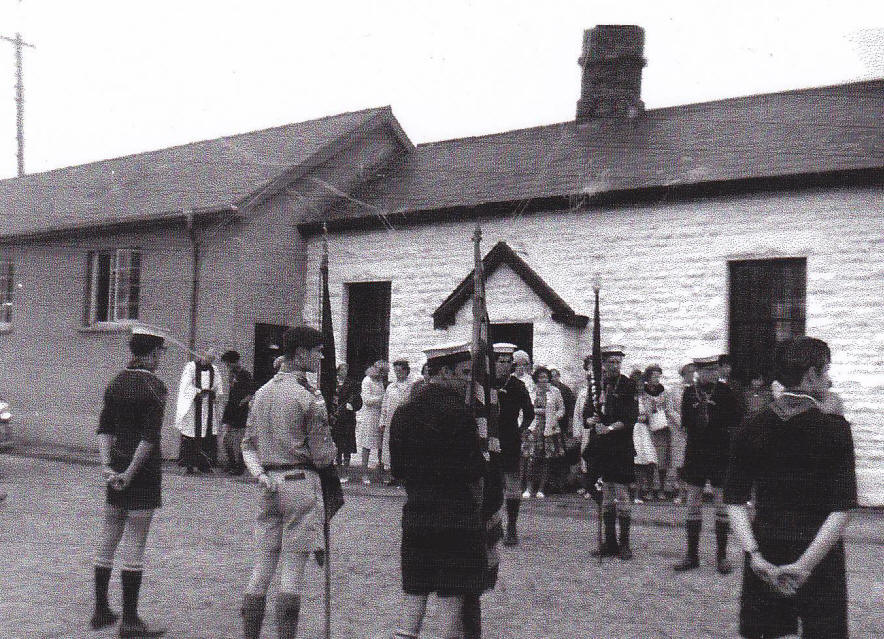
Following HMC&E
occupancy it was used by a blacksmith and then the Sea Scouts.
|
|
We Thank
Mr Rob James for giving us the two photos above.
|
|
|
 |
|
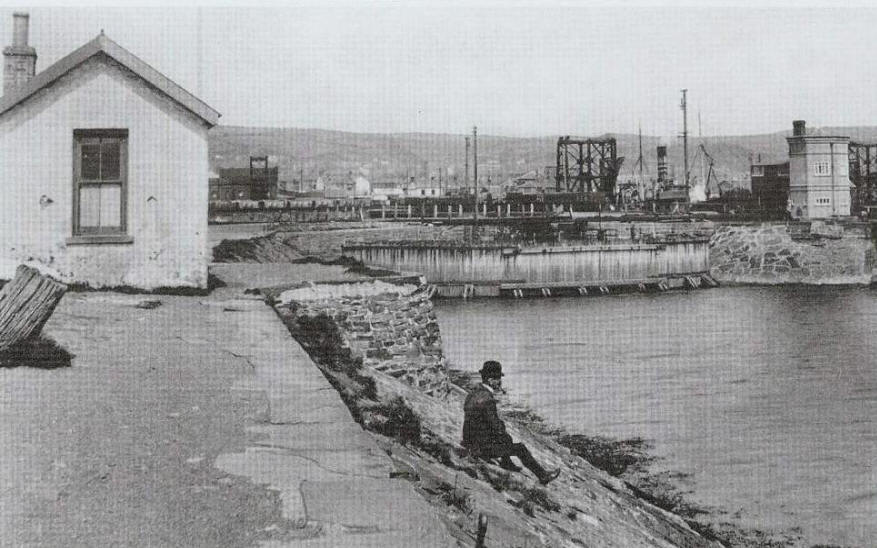
Burry Port
Dock
The photograph depicts the old Harbour Masters office on the
L/H side and the hexagonal Custom House on the R/H side. There
was a Customs presence in BP until about the late 1940's and
people remember the old CH as a ruin in the early 1950's.
Our thanks to Michael Clement &
Gaynor Mills of the Burry Port History Society for this photo
|
|
|
|
|
 |
| |
| |